How to Drive the UAZ Buhanka
Simple rules to drive safely, avoid damage, and enjoy your adventure without stress.
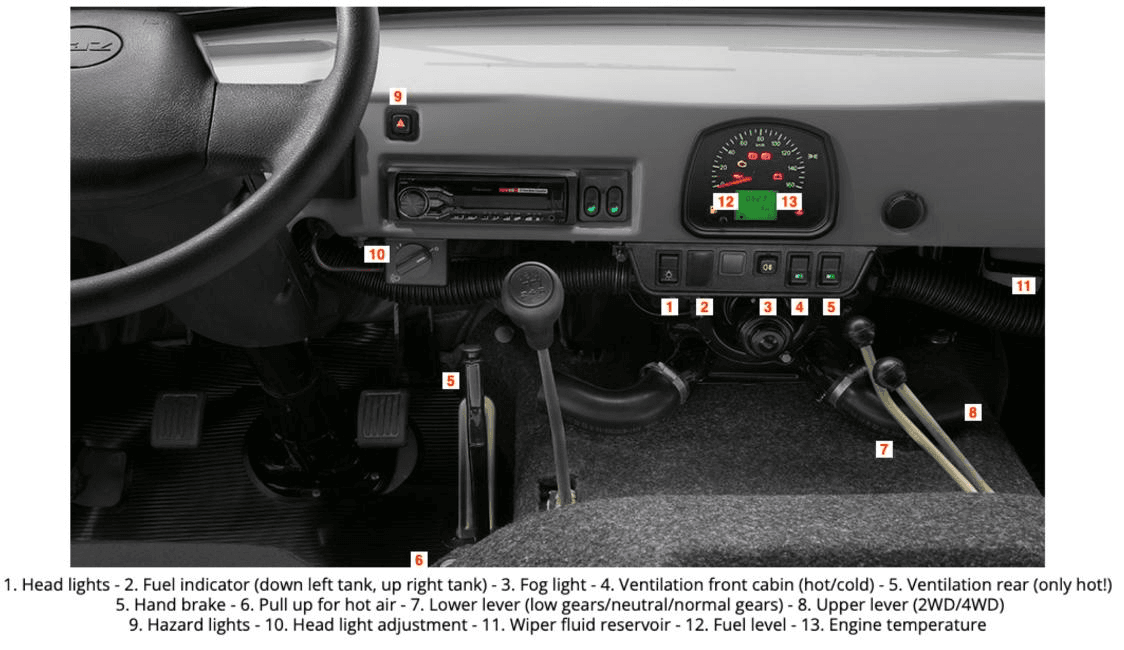
How to Engage the 4x4
Preparation
Ensure the van is STOPPED before engaging 4x4. Avoid grinding the gears!
Engaging 4x4 High
- Press the clutch while in 1st gear.
- Push the upper lever forward or away from yourself to engage 4x4 high/direct.
If Stuck in Mud
- Shift to 4x4 low/reducing only if you're stuck.
- Press the clutch and pull the lower lever to engage the reducing gear.
Driving in 4x4 Low
While in 4x4 low, do not exceed 10 km/h and avoid sharp turns. Sharp turns could damage the axle, leading to a loss of your deposit and significant headaches.
Disengaging 4x4
- Come to a complete stop.
- Ensure the lower levers are in direct.
- Engage the clutch and gently pull the upper lever towards the driver.
Fuel Efficiency
It is strongly recommended to disengage 4x4 when it's not needed, as the van consumes twice as much fuel in 4x4 mode.
Transfer Case Issues
If you hear ringing or knocking from the transfer case, please call me immediately. This could indicate gear damage.
The Transmission:
- The van has a 5-speed transmission. Engaging the gears can be a bit challenging, so it’s important to familiarize yourself with them before driving
- Tip: Run through all the gears before you start driving to get a feel for their positions
- Important: Be careful not to grind the gears, especially when shifting from 1st to 2nd gear
Fuel & Gas System
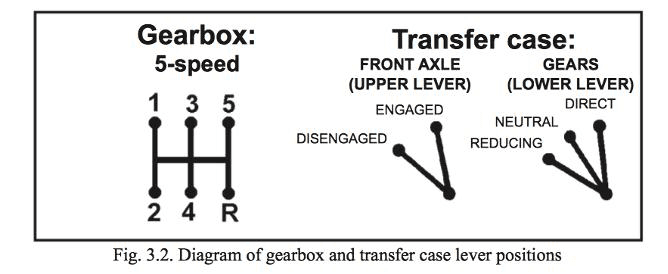
- The vans have two gas tanks: a 50L tank on the driver’s side and a 25L tank on the passenger’s side. We strongly recommend using the driver’s side tank for travel between towns.
- Expect fuel consumption of 14-16L per 100 km under normal highway conditions (not in 4x4).
- Use 95 octane fuel for the best performance; 92 octane will result in poor performance.
- Avoid filling the tank from plastic bottles in mountainous areas to prevent contamination.
- Always vent both fuel tanks when driving above 1500m to avoid pressure build-up, which can cause power loss or gas smells in the cabin.
If the Van Gets Stuck in Mud, Snow, or Water
Seek Assistance
Ask a local for help or contact us. We can send someone to assist you, but it may take 4-5 hours depending on your location. The cost for assistance can range from $150 to $350.
Use the C Hooks
Under the front of the van, you’ll find two C hooks. Please use these for towing.
Tow Strap
Utilize the tow strap provided in the van. Be cautious: if the strap breaks, you will be responsible for the cost of replacement
Shovel
Use the shovel included in the van to help dig out if needed.
Clutch Care
If you burn out the clutch while trying to get unstuck, it could take 1-2 days to repair and cost between $200 and $250
How to Change a Flat Tire
Safety First
- Ensure the van is on level ground and out of the way of traffic
- Make sure the van is stable and won't roll. Engage the handbrake and use stones or other objects to secure the van
Locate the Spare Tire
- The spare tire is located under the back of the van, behind the two doors.
Remove the Spare Tire
- Use the tire wrench to unbolt the two bolts securing the spare tire in place.
Position the Jack
- Place the tire jack on the axle of the flat tire.
- Make sure to turn the top of the jack to raise it to the required height.
Remove the Flat Tire
- Loosen all the bolts on the flat tire. Once loosened, lift the van with the jack to remove the flat tire.
Install the Spare Tire
- Place the spare tire onto the van and secure it by tightening the bolts.
- Store the damaged tire inside the van.
Repair Options
Patching a hole in a tire is straightforward and can cost around 500 to 800 SOM.